Most people know their home needs a deep clean. Few realise how far it’s actually fallen behind — until someone else sees it.
That’s what happened when we arrived at a home on Rushlily Drive in Officer last year. The client — a young professional living alone — had booked what he described as a “spring cleaning.” What we found when we walked through was something that needed considerably more than that.
This is the real story of that job: what the home looked like before we touched it, what the process of restoring it involved, what we learned from it, and why it matters for any busy person who’s been putting off calling a cleaner.
We’re sharing it — with before-and-after images — because the most genuinely useful thing a cleaning company can do is show you the truth about what neglect accumulates, how quickly it reverses with professional attention, and what an honest maintenance plan prevents.
The Client: A Busy Professional in Officer’s Growth Corridor
Officer is one of Melbourne’s fastest-growing suburbs — new estates, young professionals, people who bought their first home, moved in with good intentions, and then discovered that working full-time leaves almost no energy for the cleaning routine they’d planned.
Our client on Rushlily Drive fit that profile exactly. Early thirties, working long hours in the city, commuting on the Pakenham line. He wasn’t indifferent to cleanliness — he was simply time-poor in the way that a lot of the clients we see across Officer, Clyde North, and Berwick are time-poor. Surfaces got a wipe when they were visibly bad. The bathroom got the bare minimum. The areas he didn’t use daily — a second toilet, some corners — got nothing.
The result, compounded over months, was what we found when we arrived.
What We Found: An Honest Assessment of the Before State
The Main Bathroom
The main bathroom was the most concerning space. Looking at the toilet before we started, the condition told a clear story of infrequent cleaning combined with hard water and mineral buildup over an extended period.
The toilet seat showed heavy rust-coloured staining around the entire seat rim — dense, dark, and deeply set into the plastic. The hinge points were coated in dark buildup from moisture accumulating and oxidising around the fixing bolts. Across the toilet bowl exterior and the floor tiles immediately surrounding the base, scattered organic debris, marks, and grime had accumulated to the point where the floor’s original tile colour was difficult to read.
This isn’t unusual to us — it’s one of the most common patterns we see when a single person lives alone and the bathroom doesn’t get used by anyone else who might trigger the “this needs cleaning now” moment. The threshold for action keeps rising.
The glass shower screen in this bathroom had a light coating of soap scum that hadn’t yet calcified fully — suggesting the shower was in more regular light use than the toilet area. But the shower floor and drain area showed grime accumulation that a quick rinse doesn’t address.
The Second Toilet
The home had a second, separate toilet room. This one showed a different but equally revealing pattern — less severe in some ways, more so in others.
The toilet seat lid here had yellowing and staining on the interior surface — the underside of the lid that most people overlook during quick cleans because it’s only visible when the lid is fully raised. The floor tile grout lines throughout the room had darkened with accumulated organic material. Debris was scattered across the tile floor around the base of the toilet and near the toilet brush holder.
The toilet brush itself — visible in the images — hadn’t been replaced in some time and was no longer effective as a cleaning tool. This is worth noting, because a dirty toilet brush actively spreads contamination rather than removing it.
The Third Bathroom
A third bathroom in the home — cleaner than the others and more recently used — showed a bathroom that had received light surface attention but still needed professional detailing. The vanity and taps had accumulation that a standard wipe-down wouldn’t reach, and the overall space, while not neglected in the same way as the main bathroom, hadn’t received a proper deep clean in the time the client had lived there.
What Himaya Observed Before Starting
“What I saw in this home isn’t unusual — it’s actually a very common pattern for busy professionals living alone. The spaces you use most intensively every day — like the main bathroom — can fall behind faster than you realise, because you’re in them briefly, in a hurry, and your focus is on the task rather than the condition of the room.
The hard part of this situation is that once buildup reaches a certain stage, the standard cleaning products most people have at home don’t cut through it anymore. The toilet seat staining we saw here is mineralised — it requires dwell time with the right products and mechanical action. Wiping it with a cloth and surface spray gets you maybe 20 per cent of the way. People try, see minimal result, and give up. That’s not a character flaw. That’s using the wrong tools for the job.
The other thing I’d say about this job is that the home itself was in genuinely good condition structurally. The bathroom was a solid, well-built Officer estate home. The neglect was entirely surface-level — which is exactly the kind of thing professional cleaning completely reverses.”
The Cleaning Process: What a Professional Deep Clean Actually Involves
A spring clean — or what we more accurately call a deep house cleaning — is not a faster version of a regular clean. It’s a fundamentally different service that follows a different methodology.
Here’s what we did across this property:
Stage 1: Assessment and Product Selection
Before touching anything, we identify the specific buildup types present and select products accordingly. The toilet seat staining we found is primarily mineral and urine-based — it needs an acid-based descaler with dwell time, not a general-purpose bathroom spray. The grout discolouration needed a penetrating grout cleaner and a rotary brush, not a mop. Getting this wrong wastes time and produces poor results — and it’s the most common reason DIY deep clean attempts disappoint.
Stage 2: The Toilets — The Detail Work That Makes the Difference
For each toilet, the process went beyond what a regular clean covers:
The toilet seat was removed at the hinges to clean the fixings and the often-missed area underneath where organic buildup concentrates. Hinge bolts were individually cleaned — these are the dark spots visible in the before images that most people can’t identify and therefore never address.
Descaling product was applied under the toilet rim, inside the bowl, across the seat, and around the exterior base, and left to dwell — a minimum of 15-20 minutes for established mineral staining. This dwell time is what actually breaks down the mineral bonds that make staining look permanent. After dwell time, scrubbing with appropriate brushes (rotary head brush under the rim, standard toilet brush inside the bowl, scrubbing brush for the exterior) removed the softened deposits.
Multiple passes were needed on the main toilet. The before state was severe enough that a single product application wasn’t sufficient. We cycled through two full treatment passes to reach the result visible in the after images.
The floor tiles around each toilet were treated separately from the floor overall — targeted spot treatment on the concentrated debris areas, followed by overall tile and grout cleaning.
Stage 3: Shower Screens and Shower Areas
The glass shower screen received an anti-limescale treatment with dwell time, followed by scrubbing and squeegee work. The shower floor was scrubbed to address drain-area grime accumulation. The after image shows the result: a glass screen transparent enough to read clearly from across the room, a shower floor restored to its tile colour, and drain areas clear.
Stage 4: Vanity, Basin, and Tapware
Each vanity was detailed including behind and underneath the basin where water splatter accumulates on the cabinet surface. Tapware was descaled — Officer’s water supply, while not as hard as some Melbourne areas, still produces tapware buildup that needs periodic acid descaling to remove. After descaling and polishing, chrome tapware goes from dull and speckled to visibly bright, as seen in the after images.
Vanity cabinet exteriors, mirror frames, and the exhaust fan grille were included in the process — the detail items that never get addressed in a quick clean.
Stage 5: Floor Treatment Throughout
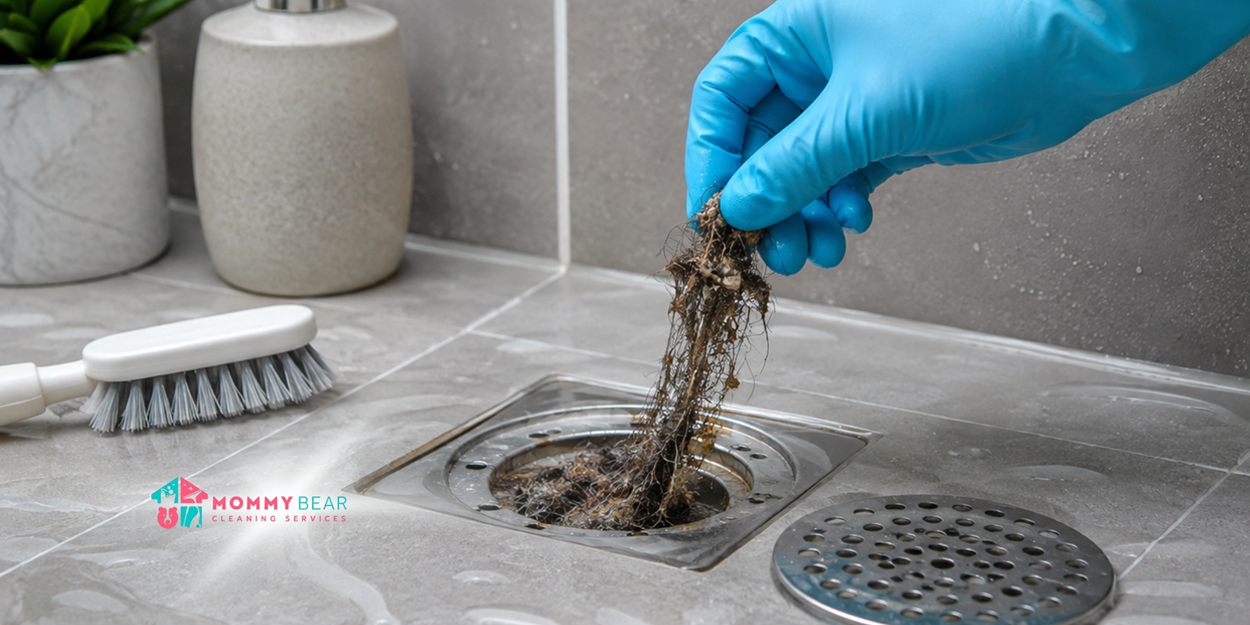
All bathroom floors were vacuumed (not swept — sweeping distributes fine particles) then mopped with appropriate tile cleaner. Grout lines throughout were scrubbed with a grout brush to address the darkened accumulation visible in the before images. The result is visible in the after photos — grout lines that read lighter and more clearly defined, tile surfaces with a clean reflective quality rather than a flat, grimed appearance.
Stage 6: Full House — Beyond the Bathrooms
The one-off spring clean extended to the rest of the home: all benchtops and surfaces, kitchen including appliance exteriors, all floors vacuumed and mopped, dusting throughout, skirting boards, window sills, and high-touch points. The bathroom was the most intensive component, but the overall clean was a full property reset from top to bottom.
The Before and After: What the Images Show
The transformation in this Officer VIC bathroom highlights the difference a professional deep clean can make. While the property wasn’t regularly used, the bathroom had developed visible staining, grime buildup, and signs of neglected maintenance that required detailed attention.
Before Cleaning
The toilet showed significant staining and mineral buildup, particularly around the seat hinges and bowl. Floor tiles appeared dull, grout lines had darkened over time, and bathroom surfaces lacked the clean, hygienic appearance expected in a well-maintained home.
After Cleaning
Following our detailed bathroom cleaning service, the toilet was thoroughly cleaned and sanitised, restoring a noticeably fresher appearance. Floor tiles were cleaned, grout lines became more defined, and bathroom fixtures regained their shine. The result was a cleaner, brighter, and more hygienic space that was easier for the homeowner to maintain moving forward.
This initial spring clean delivered such a positive result that the homeowner chose to continue with fortnightly cleaning services, becoming one of Mommy Bear Cleaning’s long-term recurring clients.
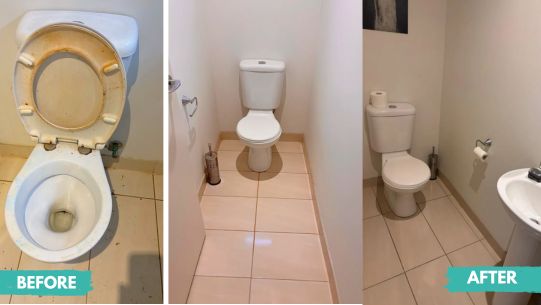
No filters or image enhancement were applied to any of these photos. This is the real before and after state.
What This Job Taught Us (And What It Should Tell You)
We’ve been cleaning homes across Melbourne for 15 years and have completed over 500 residential cleans. Jobs like this one reinforce a few things that we see consistently, and that are genuinely useful for any homeowner or renter to understand.
Neglect is non-linear. Buildup doesn’t accumulate evenly. The first few months of missed cleaning make a small difference. The next few months make a bigger one. By month twelve, you’re dealing with mineralised staining and established organic growth that requires professional products and technique to address. Catching it early is dramatically less work and less cost than catching it late.
Busy people aren’t bad at cleaning — they’re missing a system. The client on Rushlily Drive was not someone who didn’t care about his home. He was someone whose lifestyle had outpaced the cleaning routine he was trying to maintain. This is the story behind most of the deep cleans we do — not neglect from indifference, but from a life where cleaning kept getting deprioritised until the gap was too large to close on a Saturday morning.
The second toilet syndrome. In nearly every home with more than one bathroom, there’s a hierarchy — the main bathroom gets some attention, and the secondary toilet or ensuite is forgotten entirely. Bacteria and mineral buildup don’t observe hierarchies. We flag this consistently because it’s the space that always surprises clients when we show them what was accumulating there unseen.
Professional cleaning and DIY cleaning are not the same activity. This isn’t a value judgement on DIY effort. It’s about tools, products, and dwell time. The toilet seat in Image 1 was not going to change meaningfully with surface spray and a cloth. It needed acid-based chemistry sitting on the surface long enough to break mineral bonds, followed by mechanical scrubbing. That’s not something most people have at home or know to do. It’s what professional cleaning actually is.
What Happened After: From One-Off to Fortnightly Client
After the initial deep clean, the client wanted to stay at the standard we’d brought the home to. He booked a fortnightly regular clean — the same trusted cleaner returning every two weeks to maintain the baseline.
This is the most common path for clients who experience a genuine deep clean for the first time. The deep clean resets the home. The regular schedule holds it there. Combined, the two services deliver something neither achieves alone: a home that’s consistently at a level the client is genuinely comfortable with, without consuming any of his limited spare time.
What it costs per fortnight is considerably less than what the initial deep clean cost — because maintenance is always cheaper than restoration. The grout that took a rotary brush and two product applications to restore takes ninety seconds to maintain. The toilet seat that needed two dwell cycles to treat takes three minutes to keep clean. This is the compound return on professional maintenance cleaning — it keeps getting easier and faster the more consistently it’s done.
We’ve been cleaning his home ever since.
The Lesson for Busy Professionals Across Officer and Melbourne’s South-East
If you recognise any element of this story — a home that’s fallen behind, a bathroom you avoid looking at too closely, a cleaning routine that keeps getting postponed — the first step is also the most important one: a one-off deep clean that resets everything to zero.
It doesn’t take all day. It doesn’t require you to be home. And the difference between the before and after states you’ve seen in this article is the difference that one professional visit makes.
From there, a regular fortnightly maintenance schedule costs less per visit, takes less time, and prevents the kind of accumulation that turns into a restoration job.
We service Officer, Rushlily Drive and surrounding streets, all of Cardinia Shire, and right across Melbourne’s south-east — Pakenham, Berwick, Beaconsfield, Clyde North, Narre Warren, Cranbourne, and beyond.
📞 Call Himaya directly: 0449 626 424 🌐 Free quote: mommybearcleaning.com.au/contact-us
10% off your first clean. 13 Brittanica St, Officer VIC 3809.
Frequently Asked Questions
How long does a professional deep clean take for a 3-bedroom home?
For a 3-bedroom home in similar condition to this Officer property — with bathrooms requiring restoration-level attention — expect 4-6 hours for a professional team. Homes that have been maintained more recently take 3-4 hours. We assess scope honestly before quoting so there are no surprises.
Can a neglected toilet seat be fully restored, or does it need replacing?
It depends on the type and depth of staining. Mineralised staining — like the rust and calcium deposits visible in the before images in this case study — responds well to professional treatment and typically restores to white or near-white. Staining that has physically etched the plastic (often from very long-term acid or harsh chemical contact) may not fully reverse. In this job, the seat was fully restorable.
What’s the difference between a spring clean and a regular fortnightly clean?
A spring clean (or one-off deep clean) is a restoration service — it goes beyond visible surfaces to address inside cupboards, behind appliances, grout scrubbing, fixture descaling, and all the detail areas that regular cleaning doesn’t reach. A fortnightly maintenance clean maintains a home that’s already at a good standard. Most new clients start with the former and transition to the latter.
Is professional deep cleaning worth it for a rental property in Officer?
Absolutely. Officer has a significant rental market, and property managers in the City of Casey hold end-of-lease cleans to REIV inspection standard. A professionally documented clean with a bond-back guarantee eliminates the risk of bathroom-related deductions — which, based on the condition we see regularly, are among the most common dispute items in residential bonds.
How often should bathrooms be professionally cleaned in Melbourne?
For a maintained bathroom (wiped weekly), professional attention every 3-6 months prevents the kind of accumulation seen in this case study. For a bathroom in heavier use or in Melbourne’s winter humidity (which accelerates mould growth), quarterly professional cleaning is more appropriate. For a bathroom that has fallen behind — as in this job — a single deep clean restores it to a maintainable state.
What products does Mommy Bear use for stained toilets?
We use professional-grade descalers and bathroom restorers that are stronger than supermarket equivalents, require proper handling, and are matched to the specific type of staining present. All products are eco-friendly and non-toxic after appropriate rinsing — a requirement for our team given we work in family homes with children and pets.