If you’ve ever opened your oven door, noticed the thick layer of brown-black residue coating the walls, and quietly closed it again — you’re not alone.
Oven cleaning consistently ranks as the most dreaded kitchen task in Australian households. The grease bakes harder with every use. Supermarket sprays barely make a dent. And by the time you finally commit to doing something about it, the job has gone from unpleasant to genuinely difficult.
That’s exactly the kind of oven we see regularly across Officer, Pakenham, Berwick and the surrounding suburbs. Ovens that have been cooking family meals for years without a proper deep clean. And the results we achieve, even on the worst cases, consistently surprise our clients.
This guide covers everything homeowners and tenants in Melbourne’s south-east need to know about professional oven cleaning — what it actually involves, what it costs, when you need it, and why doing it yourself often makes things worse.
What happens inside an oven that never gets properly cleaned
Every time you roast, bake or grill, microscopic particles of fat, oil and food vapour land on the oven’s interior surfaces. At cooking temperatures between 180°C and 250°C, these particles undergo a chemical process called polymerisation — they bond to the metal and enamel at a molecular level.
The first layer is almost invisible. But each subsequent cooking session adds another. Over months and years, you end up with a thick, carbonised coating that no amount of household scrubbing will shift.
Here’s what that build-up actually does:
- Reduces cooking efficiency. Carbon deposits absorb heat unevenly, creating hot spots and cold zones. Your oven has to work harder to reach and maintain temperature, which increases energy consumption.
- Alters food flavour. Old grease and carbon release smoke and odour during cooking. That subtle burnt taste on your roast chicken? It’s not the seasoning — it’s the oven walls.
- Creates a genuine fire risk. Grease build-up inside the oven cavity and around the heating elements is a documented cause of kitchen fires. The thicker the layer, the higher the risk.
- Degrades seals and components. Carbonised residue around door seals stops them closing properly, which lets heat escape. Grease around fan elements restricts airflow and can cause motors to overheat.
None of this happens overnight. It’s gradual, which is why most people don’t notice until the oven is genuinely struggling.
Our recent oven cleaning project in Officer — a real case study
We recently completed a heavily soiled oven cleaning project for a homeowner in Officer. This wasn’t an oven that had been neglected deliberately — it was a busy family kitchen where the oven was used almost daily for several years without a professional clean.
What we found:
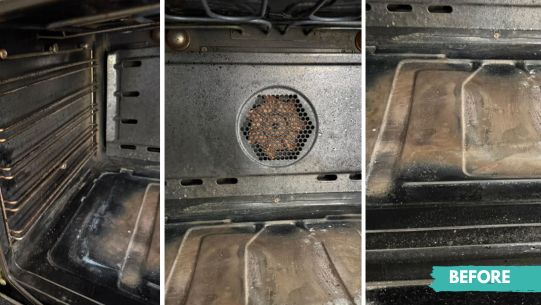
The oven cavity walls had thick, multi-layered carbon deposits that had hardened over time. The base tray was coated in burnt grease and carbonised food residue. Both wire racks were dark brown with baked-on grime, and the oven door glass had a dense brown film between the inner and outer panes — an area most homeowners don’t even realise exists.
The rangehood filters above the stovetop were similarly saturated with cooking grease, restricting airflow and reducing extraction efficiency.
Our cleaning process:
We began by removing all removable components — racks, trays, and the oven door where the design allowed safe removal. Each component was treated individually with professional-grade, non-caustic degreasing solutions. These products are specifically formulated for kitchen appliances: they break down polymerised grease without damaging enamel coatings, stainless steel or glass.
The oven cavity walls, roof and base were treated with a targeted degreasing application and given appropriate dwell time to allow the product to penetrate the carbonised layers. We then manually agitated and removed the loosened deposits using non-abrasive tools designed for oven surfaces.
The oven door glass was disassembled where possible to access the inner pane — this is where the worst discolouration typically hides, and it’s the area most DIY attempts miss entirely.
The result:
The finished oven was restored to a visibly cleaner, more hygienic condition. The grease and carbon deposits were safely removed without damage to the appliance. The oven door glass was clear, the racks were clean, and the cooking performance noticeably improved — the homeowner mentioned the oven was heating more evenly within the first week.
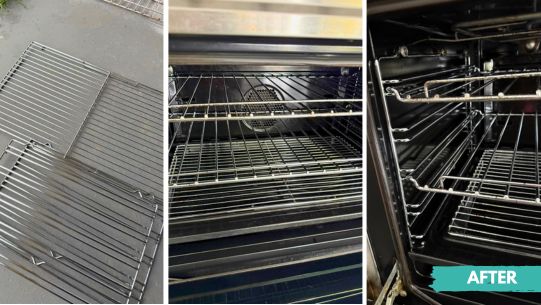
“We recently completed a heavily soiled oven cleaning project for a homeowner in Officer. Years of baked-on grease, carbon build-up and burnt food residue had accumulated throughout the oven cavity, side walls, base tray, racks and oven door glass. Our professional cleaning process safely removed the grease and carbon deposits without damaging the appliance. The finished result restored the oven to a much cleaner and more hygienic condition while improving its appearance and cooking performance.”
This is a typical example of the work we do across Officer and neighbouring suburbs including Pakenham, Beaconsfield, Berwick, Clyde North and Cranbourne. Most ovens we clean haven’t been professionally serviced in years, and the transformation is always significant.
What a professional oven cleaning service actually includes
There’s a substantial difference between wiping down your oven after a Sunday roast and a proper professional deep clean. Here’s what a thorough oven cleaning service should cover:
Oven cavity (interior walls, roof and base) All interior surfaces are degreased, carbon deposits are removed, and the enamel is restored to its original colour wherever possible. This includes the often-missed back wall behind the fan element and the roof of the oven where grease vapour settles.
Oven racks and trays Removed, soaked in professional degreasing solution, manually scrubbed, rinsed and dried. Wire racks accumulate some of the thickest grease build-up because they sit directly in the cooking zone.
Oven door and glass panels The exterior is cleaned, but more importantly, the inner glass — and the gap between double-glazed oven door panels — is accessed and cleaned. This is where brown discolouration builds up and is virtually impossible to reach with household methods.
Door seals and hinges Grease residue around the door seal is carefully removed to restore proper sealing. Hinges are cleaned to ensure smooth operation.
Stovetop and rangehood (if included) Burner grates, drip trays and the cooktop surface are degreased. Rangehood filters are removed, soaked and cleaned. The rangehood interior and exterior are wiped down.
Final inspection and testing The oven is reassembled, a visual check confirms all surfaces are clean and all components are correctly in place, and the oven is confirmed operational.
DIY oven cleaning vs professional oven cleaning — an honest comparison
We’re not going to pretend that DIY oven cleaning never works. For light, recent soiling — a spill from last week’s lasagne, a bit of splatter on the door glass — a paste of bicarbonate of soda and water, left for 20 minutes and wiped off, does a reasonable job.
But for the kind of oven most people actually have — used regularly for a year or more without a deep clean — DIY methods have real limitations.
| Factor | DIY cleaning | Professional cleaning |
|---|---|---|
| Light surface grease | Effective with bicarb paste | Effective (faster) |
| Baked-on carbon deposits | Very difficult to remove | Removed with professional degreasers |
| Oven door glass (inner pane) | Usually inaccessible | Disassembled and cleaned |
| Oven racks | Requires long soaking, heavy scrubbing | Professionally degreased and restored |
| Time required | 2–5 hours depending on condition | 1.5–2.5 hours by a trained technician |
| Chemical safety | Supermarket sprays contain caustic chemicals | We use non-caustic, eco-friendly products |
| Risk of damage | Scratching enamel, damaging seals | Trained to avoid surface damage |
| End of lease standard | Often fails inspection | Meets inspection requirements |
| Typical cost | $10–$30 in products | $100–$250 depending on oven type and condition |
The biggest gap between DIY and professional results is on the carbon. Polymerised grease that’s been baking onto oven walls for years cannot be dissolved by vinegar and bicarb. It requires commercial-grade alkaline degreasers with appropriate dwell time, applied by someone who understands the specific enamel or stainless steel coating on your appliance.
Using the wrong product — or the right product too aggressively — can permanently damage oven surfaces, strip protective coatings, or etch glass.
How much does professional oven cleaning cost in Melbourne’s south-east?
Pricing varies depending on the oven type, its condition, and what’s included. Here’s what you can generally expect across Officer, Pakenham, Berwick, Cranbourne and surrounding suburbs:
| Service | Typical price range |
|---|---|
| Single oven (60cm, standard condition) | $100–$180 |
| Single oven (60cm, heavily soiled) | $150–$220 |
| Double oven | $200–$300 |
| Wide oven (90cm) | $180–$250 |
| Stovetop / cooktop add-on | $40–$80 |
| Rangehood filter cleaning | $40–$70 |
| Oven + stovetop + rangehood bundle | $180–$320 |
These figures are based on current market rates across Melbourne’s south-east suburbs as of 2026. Prices can be higher for severely neglected appliances that require extended treatment time, and lower when bundled with other cleaning services such as end of lease cleaning or a full house clean.
At Mommy Bear Cleaning, we provide transparent quotes based on the actual condition of your oven. No hidden fees, no surprise charges on the day.
When you should book a professional oven clean
Not every oven needs professional attention every month. But there are clear situations where it makes sense:
Every 6–12 months for regular home use. If you cook most nights and roast regularly, an annual professional clean prevents the kind of heavy build-up that becomes genuinely difficult (and expensive) to remove.
Before selling your home. A clean oven signals a well-maintained kitchen. It’s one of those small details that buyers and their agents notice. We regularly clean ovens in Officer, Beaconsfield, Berwick and Narre Warren for homeowners preparing for sale.
Before or during end of lease cleaning. Oven grease is the single most commonly cited kitchen cleaning failure at Victorian rental inspections. Property managers across Pakenham, Clyde North, Cranbourne, Hampton Park and Dandenong routinely check oven interiors, racks, door glass and seals. If you’re moving out, a professional oven clean should be part of your vacate cleaning plan.
According to the Victorian Residential Tenancies Bond Authority, cleaning-related issues appear in roughly two-thirds of all bond disputes. The oven and rangehood are among the most frequently flagged areas.
After a kitchen renovation. Construction dust, plaster particles and paint residue settle inside appliances. A post-renovation clean ensures your oven is safe and hygienic before you start cooking.
When you notice signs of poor performance. Uneven heating, unusual odours during cooking, visible smoke when the oven is empty at high temperature, or a brown film on the door glass — all of these indicate that grease build-up is affecting your oven’s operation.
Eco-friendly oven cleaning — what it means in practice
Many homeowners across Officer and surrounding suburbs are increasingly concerned about the chemicals used in their homes, especially in the kitchen where food is prepared.
Traditional oven cleaning products — the ones sold at Coles and Woolworths with heavy chemical warnings on the label — typically contain sodium hydroxide (caustic soda) or potassium hydroxide. These are effective degreasers, but they produce strong fumes, can burn skin on contact, and leave chemical residue inside the oven that requires thorough rinsing before it’s safe to cook again.
At Mommy Bear Cleaning, we use professional-grade, non-caustic cleaning products that are:
- Biodegradable — they break down safely in the environment.
- Low-odour — no harsh chemical fumes filling your kitchen.
- Food-safe once dry — your oven is ready to use shortly after cleaning.
- Safe around children and pets — an important consideration in family homes, which is most of our clients across Officer, Pakenham, Emerald and Upper Beaconsfield.
Eco-friendly doesn’t mean less effective. Professional non-caustic degreasers work through enzyme action and controlled alkalinity rather than brute chemical force. They require slightly longer dwell time but achieve the same depth of clean without the risks.
Oven types we clean across Melbourne’s south-east
Every oven is different, and the cleaning approach needs to match. Here’s what we regularly work on:
Standard built-in electric ovens (60cm) — The most common oven in Australian kitchens. Typically features a fan-forced element on the back wall and a grill element on the roof. We clean the cavity, racks, trays, door glass and seals.
Wide ovens (90cm) — Common in larger family homes across Berwick, Beaconsfield and Officer South. These have a significantly larger cavity and often include a separate grill compartment. They require more time and product but follow the same process.
Double ovens — Two stacked cavities, each requiring individual cleaning. Often found in established homes across Narre Warren, Endeavour Hills and Hallam. The upper cavity is frequently used for grilling and accumulates heavy grease on the roof.
Freestanding cookers — Combined oven and stovetop units. We clean both the oven cavity and the cooktop surface, including burner caps, trivets and drip trays.
Gas ovens — Require careful handling around gas components. We clean the cavity and racks but avoid interfering with gas jets or ignition elements.
Pyrolytic ovens — These have a self-cleaning cycle that heats to approximately 500°C and turns residue to ash. While the self-clean function handles light build-up, it often can’t fully remove thick, polymerised grease — and it can produce significant smoke and odour. We can deep clean pyrolytic ovens when the self-clean cycle isn’t cutting it.
Commercial and industrial ovens — We service small commercial kitchens across Officer, Pakenham, Cardinia and surrounds. Commercial ovens require more intensive degreasing due to heavier use and higher grease volumes.
End of lease oven cleaning — why it matters for your bond
If you’re a tenant preparing to move out of a rental property in Victoria, oven cleaning deserves your full attention.
Property managers across Melbourne’s south-east — from Cranbourne and Clyde North through to Dandenong and Hampton Park — follow a standardised outgoing inspection checklist. The kitchen section specifically covers:
- Oven interior cavity (walls, roof, base)
- Oven racks and trays (removed and inspected)
- Oven door glass (inside and between panes)
- Door seals
- Stovetop surface and burners
- Rangehood filters and canopy
A “wipe down” is not sufficient. Agents will open the oven door, pull out the racks, and look at the glass from multiple angles. If grease is visible, that’s a cleaning failure.
The cost of having your property manager organise a re-clean is almost always higher than arranging it yourself in advance. And if it goes to dispute at VCAT (Victorian Civil and Administrative Tribunal), having a receipt from a professional cleaning company significantly strengthens your position.
We include professional oven cleaning as part of our end of lease cleaning service across Officer, Pakenham, Beaconsfield, Berwick, Clyde North, Cranbourne, Narre Warren, Hallam, Dandenong, Endeavour Hills and Hampton Park.
Five practical tips to keep your oven cleaner between professional services
Professional cleaning handles the deep accumulated grime. But these habits extend the time between cleans and make each subsequent service faster (and potentially cheaper):
- Wipe spills within 24 hours. A fresh splatter takes 30 seconds to wipe. The same splatter after 50 cooking cycles takes 30 minutes to scrub.
- Use oven liners on the base tray. A non-stick, reusable oven liner catches drips before they carbonise on the oven floor. They cost around $15 from Kmart or Big W and last for months.
- Cover dishes when roasting. Aluminium foil or a roasting lid dramatically reduces grease splatter on the oven walls and roof.
- Run a quick steam clean monthly. Place an oven-safe dish filled with water and a squeeze of lemon juice in the oven at 150°C for 30 minutes. The steam loosens surface grease and freshens the interior. Wipe down once cool.
- Clean racks in the dishwasher or bathtub. If your dishwasher can handle it, run the racks through on a hot cycle. Alternatively, soak them in the bathtub with hot water and a cup of bicarbonate of soda for two hours, then scrub with a non-scratch scourer.
None of these replace a professional deep clean. But they meaningfully reduce grease accumulation between services.
Why homeowners across Officer and surrounding suburbs choose Mommy Bear Cleaning
We’re a family-owned cleaning business based in Officer, VIC 3809. We’re not a franchise. We’re not a faceless platform. We live and work in the same community we serve.
Our service area covers Officer, Pakenham, Beaconsfield, Berwick, Clyde North, Cranbourne, Narre Warren, Narre Warren South, Officer South, Cardinia, Emerald, Cockatoo, Gembrook, Upper Beaconsfield, Hallam, Dandenong, Endeavour Hills, and Hampton Park.
What sets us apart:
- Real local knowledge. We understand the housing stock in Officer and the south-east corridor — the common oven brands, the typical kitchen layouts, the rental market conditions that drive end-of-lease cleaning demand.
- Transparent pricing. We quote based on the actual condition of your oven. No call-out fees hidden in the fine print.
- Eco-friendly products. Non-caustic, low-odour, biodegradable cleaning solutions that are safe for families and pets.
- Part of a full cleaning service. Oven cleaning can be booked as a standalone service or bundled with regular house cleaning, deep cleaning, end of lease cleaning, carpet steam cleaning, or window cleaning.
- Genuine before and after results. The case study in this article is real work we completed for a real client in Officer. We’re proud of every oven we restore.
Book your professional oven cleaning
Whether your oven needs its first professional clean in years, or you’re preparing for an end of lease inspection next week, we’re here to help.
We clean ovens across Officer, Pakenham, Berwick, Beaconsfield, Clyde North, Cranbourne, Narre Warren and all surrounding suburbs in Melbourne’s south-east.
To book or request a quote:
- Visit mommybearcleaning.com.au
- Call us directly
- Use our online booking form
Your oven works hard for your family. Let us return the favour.
Frequently Asked Questions (FAQs)
1. How much does professional oven cleaning cost in Officer, VIC?
Professional oven cleaning in Officer typically costs between $100 and $250 depending on the oven type and condition. A standard 60cm single oven in moderate condition is usually $100–$180. Double ovens, 90cm wide ovens, and heavily soiled appliances cost more due to the additional time and product required. At Mommy Bear Cleaning, we provide upfront quotes with no hidden fees.
2. How long does a professional oven clean take?
Most single oven cleans take between 1.5 and 2.5 hours. Double ovens or severely neglected appliances may take up to 3 hours. The cleaning process includes disassembly of removable parts, application and dwell time for degreasing products, manual agitation and removal of deposits, cleaning of door glass, and reassembly.
3. Do I need to be home during the oven cleaning?
We recommend being home when we arrive so we can discuss any specific concerns and access the kitchen. However, many clients provide access and continue with their day while we work. We’ll let you know when the clean is complete and walk you through the result.
4. Are the cleaning products you use safe around children and pets?
Yes. We use professional-grade, non-caustic, biodegradable cleaning products that are low-odour and safe for family environments. Unlike many supermarket oven cleaners that contain sodium hydroxide, our products don’t produce harsh fumes or leave toxic residue inside the oven.
5. Can you clean between the glass panels on my oven door?
In most oven models, yes. The glass between the inner and outer oven door panels is where the worst brown discolouration builds up — and it’s the area that DIY cleaning almost always misses. We disassemble the door where the design safely allows it to access and clean this hidden surface.
6. Is oven cleaning included in your end of lease cleaning service?
Yes. Our end of lease cleaning service includes professional oven cleaning as standard across all properties in Officer, Pakenham, Beaconsfield, Berwick, Clyde North, Cranbourne, Narre Warren, Hallam, Dandenong and surrounding suburbs. The oven is one of the most commonly failed areas at Victorian rental inspections, so we give it thorough attention.
7. How often should I get my oven professionally cleaned?
For a household that cooks regularly (most nights), we recommend a professional clean every 6 to 12 months. Heavy oven users — families who roast, bake and grill frequently — may benefit from every 6 months. Light users can stretch to annually. Regular maintenance between cleans (wiping spills promptly, using oven liners) extends the interval.
8. Can you remove the brown stain from my oven glass?
In most cases, yes. The brown film on oven door glass is caused by vaporised cooking grease condensing on the glass surface and baking on over time. Our professional degreasing products dissolve this residue and restore clarity to the glass. In rare cases where the discolouration has etched into the glass over many years, some faint marking may remain, but we’ll let you know upfront if that’s the case.
9. Do you clean rangehoods and stovetops as well?
Yes. We offer stovetop cleaning and rangehood filter cleaning as add-on services that pair naturally with an oven clean. Rangehood filters saturated with cooking grease restrict airflow and are a fire hazard. We remove the filters, degrease them, and clean the rangehood canopy interior and exterior.
10. Will professional cleaning damage my oven?
No. Our technicians are trained on the specific requirements of different oven types and surfaces. We use non-abrasive tools and non-caustic products designed for kitchen appliances. We avoid heating elements, gas components, and electronic controls. The goal is always to remove grease and carbon without affecting the oven’s finish or function.
11. Can you clean a pyrolytic (self-cleaning) oven?
Yes. While pyrolytic ovens have a self-clean cycle that heats to around 500°C, this function has limitations. It often produces significant smoke and odour, may not fully remove thick carbonised deposits, and doesn’t clean the door glass effectively. We can deep clean pyrolytic ovens manually with products that are safe for their specialised enamel coatings.
12. What areas do you service for oven cleaning?
We’re based in Officer, VIC 3809 and service all surrounding suburbs in Melbourne’s south-east including Pakenham, Beaconsfield, Berwick, Clyde North, Cranbourne, Narre Warren, Narre Warren South, Officer South, Cardinia, Emerald, Cockatoo, Gembrook, Upper Beaconsfield, Hallam, Dandenong, Endeavour Hills, and Hampton Park.
13. Can I use my oven straight after a professional clean?
With the non-caustic, eco-friendly products we use, your oven is typically ready to use within a short time after the clean — usually within 30 to 60 minutes once all surfaces are dry. We’ll advise you on the specific timeframe on the day. There’s no need for multiple rinse cycles or extended airing like with caustic chemical cleaners.
14. What’s the difference between oven cleaning and oven restoration?
Oven cleaning removes grease, carbon and food residue to restore hygiene and function. Oven restoration goes further — addressing discolouration, staining, minor surface damage, and returning the oven to as close to its original condition as possible. Our deep cleaning service achieves restoration-level results on most domestic ovens. Severely damaged or commercial appliances may require specialist restoration.
15. Do you offer same-day or next-day oven cleaning?
We accommodate urgent requests whenever our schedule allows. End of lease cleaning clients often need fast turnaround before inspection deadlines, and we prioritise these bookings. Contact us directly and we’ll do our best to fit you in.