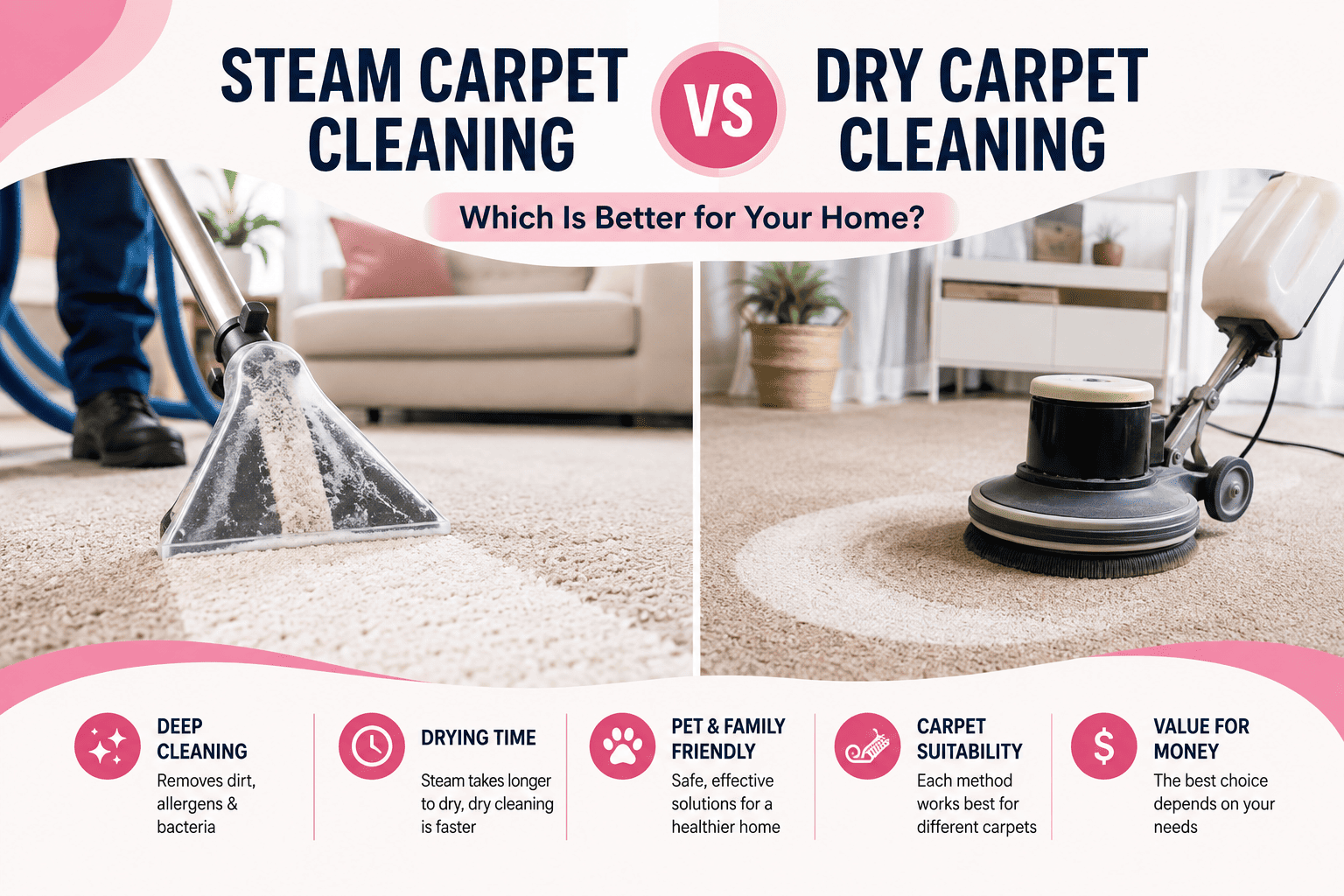
If your carpet genuinely needs a deep clean, professional hot water extraction, commonly called steam carpet cleaning, is usually the stronger choice for many residential carpets.
It applies cleaning solution and water to the carpet, loosens soil and then extracts that moisture together with the suspended dirt. Carpet manufacturers including Shaw specifically recommend hot water extraction for periodic carpet cleaning.
Dry or low moisture carpet cleaning has a different strength.
It uses substantially less moisture and can be useful when the carpet needs maintenance cleaning, the area must return to use quickly, or the carpet itself requires a more cautious approach to moisture.
So I would not choose between the two methods simply by asking which one sounds more powerful.
I would look at four things first:
How dirty is the carpet? What type of carpet is it? What are we trying to remove? How important is drying time?
Those answers usually make the decision much easier.
First, steam carpet cleaning usually does not mean cleaning with steam
This terminology causes more confusion than almost anything else in carpet cleaning.
What homeowners commonly call steam carpet cleaning is normally hot water extraction.
A professional hot water extraction process generally involves applying a suitable cleaning solution or pretreatment, introducing water into the carpet and then extracting the water together with loosened soil.
The Carpet and Rug Institute recognises extraction as a deep cleaning process and independently tests professional extractors for their ability to remove soil and recover moisture without causing unacceptable appearance changes.
Shaw also describes hot water extraction as commonly being called steam cleaning even though literal steam is not what performs the cleaning process.
That distinction matters because homeowners sometimes assume that hotter automatically means cleaner.
It does not.
A good carpet clean depends on the complete process.
Soil needs to be identified.
Appropriate pretreatment may be required.
The carpet needs sufficient agitation or dwell time where appropriate.
Then the loosened soil, cleaning solution and moisture need to be properly extracted.
More heat or more water by itself does not guarantee a better clean.
What is dry carpet cleaning?
“Dry carpet cleaning” is an umbrella term rather than one single cleaning process.
Some systems use an absorbent compound that is worked through the carpet before being recovered.
Others use low moisture cleaning agents such as encapsulation products.
These systems can differ considerably, so it is misleading to describe every dry carpet cleaning service as if the same powder and machine are always used.
Another useful point is that dry does not necessarily mean completely moisture free.
Low moisture systems can still use cleaning solutions. They simply use much less moisture than a full extraction process.
The Carpet and Rug Institute recognises encapsulation as a legitimate interim carpet maintenance method and separately tests encapsulating products and interim cleaning systems.
For the homeowner, the practical advantage is straightforward.
Less moisture generally means less drying downtime.
The tradeoff is that a maintenance focused low moisture process is not trying to do exactly the same job as a deeper extraction clean.
Steam cleaning vs dry cleaning at a glance
| Factor | Hot water extraction | Dry or low moisture cleaning |
|---|---|---|
| Main purpose | Deeper soil removal | Maintenance cleaning and faster turnaround |
| Moisture used | More | Less |
| Embedded soil | Strong option when correctly performed | Depends on system and soil level |
| Heavily soiled residential carpet | Often the more appropriate choice | May not provide enough restorative cleaning |
| Light maintenance | Effective, but may be more than necessary | Often well suited |
| Drying | Requires drying time | Usually faster |
| Stain treatment | Allows pretreatment followed by extraction | Depends on stain and system |
| Carpet suitability | Suitable for many carpets when correctly assessed | Useful where low moisture is preferable |
| Commercial downtime | May be inconvenient in some settings | Major advantage of low moisture methods |
| Unusual or moisture sensitive carpets | Needs assessment first | May sometimes be preferable |
The mistake is treating that table as a scoreboard.
The correct method depends on what the carpet actually needs.
Which method cleans deeper?
For a residential carpet with accumulated soil through the pile, hot water extraction generally has the advantage.
That is because the process is designed not only to apply a cleaning agent but to recover loosened soil through extraction.
Shaw states that hot water extraction provides its preferred capability for carpet cleaning, while the Carpet and Rug Institute classifies extraction equipment as deep cleaning systems and evaluates it for soil removal and residual moisture.
Low moisture systems are valuable, but the Carpet and Rug Institute itself distinguishes low moisture interim maintenance from deeper cleaning intended to remove more deeply embedded soil.
For a lightly soiled office carpet that receives frequent professional maintenance, a low moisture system can make excellent practical sense.
For the family room where years of tracked soil, food residue and general household use have accumulated, I am usually looking for a deeper extraction process.
Those are two different cleaning jobs.
Heavily soiled carpet usually changes the decision
This is where I would usually lean towards hot water extraction.
If the carpet only looks slightly dull between professional cleans, a maintenance process may be enough.
If traffic lanes are clearly darker, the carpet feels loaded with soil, spills have accumulated or the fibres have not been professionally cleaned for a long time, a surface refresh is solving the wrong problem.
You need to remove more of what has built up.
A proper professional process may involve:
- inspecting the carpet and identifying problem areas
- thoroughly vacuuming loose dry soil
- applying appropriate pretreatment
- allowing the treatment time to work where necessary
- agitating difficult areas when appropriate
- extracting the loosened soil and solution
- making sufficient recovery passes to remove moisture
- dealing with remaining spots individually
The equipment matters, but technique matters as well.
The Carpet and Rug Institute notes that carpet cleaning equipment varies in how effectively it removes soil and recovers water. That is one reason its testing program measures cleaning effectiveness and residual moisture rather than simply asking how much water or heat a machine produces.
Which dries faster?
Dry or low moisture carpet cleaning normally wins this comparison.
That is one of its biggest genuine advantages.
But I would be cautious about any company promising that every carpet will dry in an exact number of hours.
Drying after hot water extraction depends on several factors, including:
- how much moisture was applied
- how effectively it was extracted
- carpet construction
- pile density
- ventilation
- airflow
- indoor temperature
- humidity
- the amount of treatment the carpet required
Mommy Bear currently advises customers that drying after its steam carpet cleaning service commonly varies according to airflow, humidity, carpet fibre and pile thickness.
This becomes especially relevant in Victoria.
A carpet cleaned in a well ventilated home with good airflow may behave very differently from the same carpet cleaned in a closed room during cooler conditions.
That does not mean you should avoid hot water extraction in winter.
It means drying conditions should be part of the planning.
When should drying time outweigh cleaning depth?
This is the question generic comparisons often miss.
Imagine two carpets.
The first is badly soiled after years of family traffic and needs substantial soil removed.
The second belongs to a business that receives frequent maintenance cleaning and needs the floor back in use with minimal interruption.
For the first carpet, sacrificing cleaning depth purely to save drying time may be a poor trade.
For the second, rapid return to use may be one of the most important requirements.
That is why the same cleaning recommendation does not suit every property.
Which method is better for stains?
Neither method should be judged simply by counting stains.
The type of stain matters more.
Coffee is different from cooking oil.
Mud is different from red wine.
A fresh spill is different from something that has been repeatedly treated with supermarket spot remover.
Pet urine presents another set of problems again.
Good professional stain treatment starts by working out what is likely to be in the carpet and choosing a suitable treatment.
Hot water extraction can be very useful because after appropriate pretreatment, loosened material and cleaning solution can be flushed and recovered from the carpet.
But that does not mean extraction automatically removes every stain.
Some stains alter the colour of the fibre.
Some have been present for too long.
Some previous DIY products can set a stain, leave residue or affect later treatment.
Some contamination has travelled beneath the carpet into the backing or underlay.
Godfrey Hirst advises homeowners to deal with spills promptly and warns that incorrect stain removal attempts can contribute to permanent staining, distortion or colour loss.
The Carpet and Rug Institute likewise advises prompt treatment and notes that stubborn spills may require professional assessment and treatment.
So if a cleaner promises that a particular method will remove every stain before seeing the carpet, I would be cautious.
What about pet stains and pet odours?
Pet homes are a good example of why choosing a method is only part of the job.
Loose hair and dry soil should be thoroughly removed first.
Visible spotting may need dedicated pretreatment.
Urine contamination may be limited to the carpet pile, or it may have reached the backing, underlay or even the subfloor.
Those are very different situations.
Hot water extraction gives a professional the ability to rinse and recover loosened contamination from the carpet, which can make it particularly useful in pet households.
But it should not be marketed as a guaranteed cure for every pet odour.
If contamination has travelled below the carpet, cleaning the visible fibres alone may not resolve the entire problem.
Mommy Bear’s live service page currently states that its carpet cleaning process includes inspection, pretreatment and hot water extraction, with additional treatment potentially required for more serious pet contamination.
That is the more realistic way to think about pet carpet cleaning.
The cleaning method matters.
The location and severity of the contamination matter just as much.
What is better for homes with children?
I would not choose a carpet cleaning method simply because somebody labels one option “safer for children”.
The better questions are:
What products are being used? Are they suitable for this carpet? Is the solution being properly recovered or removed? Has the carpet been allowed to dry as directed?
The cleaning method and the cleaning chemistry are not the same thing.
A hot water extraction machine can be used with different cleaning solutions.
A low moisture system can also use different cleaning products.
So statements such as “steam means no chemicals” or “dry cleaning means harsh chemicals” are too simplistic.
Mommy Bear states that its carpet service uses biodegradable cleaning solutions as part of its hot water extraction process.
For parents, I would focus on the actual products being used and follow the cleaner’s instructions about allowing the carpet to dry before children return to the area.
What about wool carpet?
This is another subject where online advice becomes too absolute.
You will often see:
Wool must be dry cleaned.
That is too broad.
You may also see:
Steam cleaning is safe for every wool carpet.
That is too broad as well.
Wool requires careful cleaning chemistry, moisture control and professional judgement.
Godfrey Hirst advises gentle maintenance for wool, recommends professional cleaning for deeper cleaning and specifically warns against inappropriate heat, harsh chemicals and over wetting.
The correct question is not simply:
Is wool steam cleaned or dry cleaned?
It is:
What does the manufacturer recommend for this particular carpet, and can the technician safely perform the required method?
The same caution applies to unusual natural fibres, delicate carpet, older flooring and any carpet where construction or previous damage is uncertain.
If there is doubt, the manufacturer’s care instructions should take priority over a generic blog article.
Does more water produce a better steam clean?
No.
This is worth saying because homeowners sometimes associate a wetter carpet with a more powerful clean.
A good hot water extraction service needs enough moisture to perform the cleaning process effectively, but the job also depends on recovering that moisture.
The Carpet and Rug Institute specifically includes residual moisture in its extractor testing criteria.
Shaw warns that excessive wetting combined with poor extraction can contribute to problems with the carpet and backing.
So I would pay more attention to the complete cleaning and extraction process than to how much water a cleaner says the machine uses.
The objective is not to soak the carpet.
The objective is to loosen soil and then remove it effectively.
Why professional extraction equipment matters
The machine should not be treated as the entire service, but extraction performance does matter.
A professional cleaner needs enough recovery capability to remove the cleaning solution, loosened soil and moisture from the carpet after treatment.
The Carpet and Rug Institute tests professional extractors for:
- cleaning effectiveness
- surface appearance change
- residual moisture
That is useful because it reflects what actually matters to the customer.
Did the equipment remove soil?
Did it avoid unacceptable carpet damage?
Did it recover enough moisture?
This is also why two companies both advertising “steam cleaning” can deliver different results.
The cleaning process, products, equipment, operator technique and carpet assessment all affect the result.
When dry or low moisture cleaning makes more sense
There are situations where I would seriously consider the low moisture option.
You need very little downtime
Commercial environments are the obvious example.
If carpet must return to service quickly, reduced drying time can outweigh the benefit of a deeper extraction clean.
The carpet mainly needs maintenance
If professional cleaning happens regularly and there is little embedded soil, an interim low moisture process may be appropriate.
The Carpet and Rug Institute specifically discusses low moisture encapsulation as an interim maintenance technique between deeper cleaning cycles.
The flooring requires careful moisture management
Some unusual carpet constructions or fibres deserve a conservative approach.
That does not automatically mean dry cleaning is required, but it does mean the carpet should be identified before choosing a method.
The manufacturer specifies a particular care method
Always follow that.
A carpet warranty or care document is more relevant to your specific flooring than a generic internet comparison.
When I would normally lean towards hot water extraction
For many residential properties around Officer and Melbourne’s south east, I would normally consider hot water extraction when:
- the carpet has significant general soiling
- traffic lanes are becoming obvious
- dirt has accumulated deeper through the pile
- spills require professional pretreatment
- pet related contamination needs more than a surface refresh
- the carpet has gone a long time without professional deep cleaning
- the manufacturer recommends extraction
- the homeowner wants a genuine periodic deep clean rather than interim maintenance
That recommendation is also consistent with guidance from Shaw, which identifies hot water extraction as its preferred carpet cleaning system.
Mommy Bear uses this method for its professional steam carpet cleaning service in Officer.
The important part is that the recommendation should follow inspection of the carpet rather than simply assuming every floor covering needs the same treatment.
A five question test before choosing your carpet cleaning method
If you are still unsure, answer these five questions.
1. Is the carpet lightly soiled or genuinely dirty?
Light maintenance and embedded soil are different cleaning jobs.
The heavier the build up, the more I would consider proper extraction.
2. How quickly must the area return to use?
If the room absolutely cannot be unavailable for normal drying, low moisture cleaning becomes more attractive.
3. What is the carpet made from?
Check the manufacturer information if you have it.
Natural fibres and unusual constructions deserve more caution than a generic recommendation.
4. Are stains or pet accidents involved?
If yes, the cleaner should assess the contamination rather than simply run the same process across the entire floor.
5. What does the carpet manufacturer recommend?
This can settle the argument immediately.
If the manufacturer specifies periodic hot water extraction, follow that requirement.
If the flooring has special cleaning restrictions, follow those instead.
Steam carpet cleaning vs dry cleaning: which should you choose?
For many residential carpets that need a deeper professional clean, I would choose hot water extraction.
It provides a practical way to apply cleaning treatment and then extract loosened soil, cleaning solution and moisture from the carpet. Major carpet industry sources recognise extraction as a deep cleaning process, and manufacturers such as Shaw specifically recommend it for periodic cleaning.
I would consider dry or low moisture carpet cleaning where rapid drying is particularly important, the job is primarily maintenance cleaning, or the carpet’s construction or manufacturer instructions make lower moisture the more appropriate approach.
That is the real distinction.
It is not:
Steam good. Dry bad.
It is:
What does this carpet need removed, and which method can do that safely and effectively?
For a family home with ordinary synthetic residential carpet and accumulated household soil, that answer will often point towards hot water extraction.
For a regularly maintained commercial carpet that needs minimal downtime, it may point in the other direction.
And for wool, unusual fibres or older carpet, inspection and manufacturer guidance should come before either recommendation.
If you are in Officer or Melbourne’s south east and your carpet appears to suit extraction cleaning, Mommy Bear Cleaning Services provides steam carpet cleaning using hot water extraction.
If you are unsure about the carpet type, stains or level of soiling, it is better to describe the problem first rather than booking based only on the name of the method. You can contact Mommy Bear for a carpet cleaning quote and explain what is happening with the carpet before deciding on the service.